

We can arrive at halftime in life with plenty of experience and a surprisingly heavy suitcase. Along with our skills and accomplishments, we carry disappointments, regrets, words we wish someone had never said, and a few words we wish we could take back. Unfortunately, emotional baggage does not come with wheels. We drag it into relationships, decisions, and the next chapter of our work.
Today we’re talking about moving from brokenness to purpose by developing practical life tools: rebuilding our sense of worth, forgiving others and ourselves, and recognizing when blame has become a place we live. We cannot rewrite every experience. We can begin choosing how we respond and what we build from here.
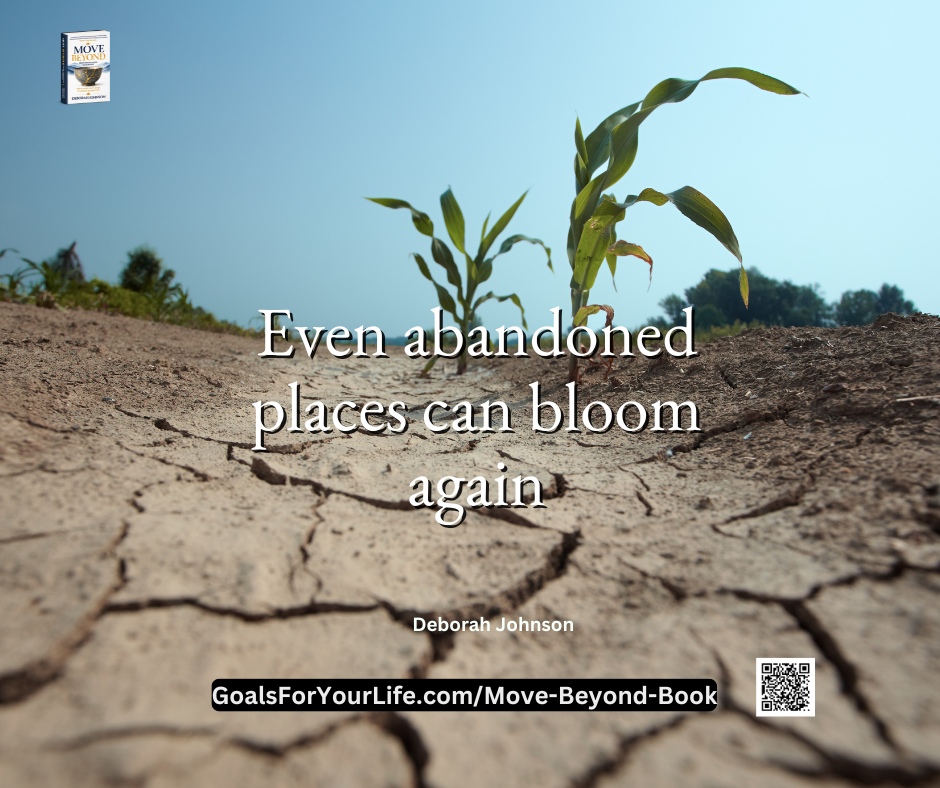
That is a central message of my book, MOVE BEYOND: From Brokenness to Purpose. “Beauty isn’t found in what was never broken—it’s revealed in what has been restored.” Restoration takes more than an inspiring sentence. It asks us to notice what needs attention and do the work of rebuilding, one honest choice at a time. In this article (show) we are covering mindsets and actions that can help you move forward.
When a Difficult Experience Becomes an Identity
Rebuild Self-Esteem with Truth and Practice
Low self-esteem can sound remarkably convincing. Our self-talk may tell us, “You always mess things up,” or “Everyone else has something you don’t—you’re just not measuring up.” We might never speak that way to a friend, yet we give our own inner critic unlimited microphone time. Apparently, just like that little “Ever-ready” commercial, it keeps going and going and rarely needs to recharge its battery.
One useful tool is a simple three-column page. In the first column, write the thought: “I have nothing valuable to offer.” In the second, write the evidence you are overlooking: a skill you developed, a problem you solved, or someone you helped. In the third, write a more accurate statement: “I have experience I can use, and I can develop the skills I still need.”
What this does is help to change the self-talk, the language. The goal is an honest assessment. You want to be real. You honestly may need training or more education in a certain area. Maybe you’ve made a mistake or a misjudgment. Neither of those erases your worth. I strongly believe our worth begins with being created and loved by God; we were created on purpose. Our worth doesn’t rise and fall with applause, with our 15 minutes of fame, with productivity, or even the number of people who like our posts!
Changing our self-talk is the first step, then comes the hard work of putting new and revised beliefs into practice. Making lists are short-term fixes but putting beliefs into practice is a long-term project—and that’s the mindset here. But you have to start. Begin with one specific commitment or task. Changing a response or habit takes consistency with tiny steps that are not overwhelming. Those small steps eventually lead to larger steps.
The practical side of this is to finish a small task, sign up for a course and actually start the course, or practice a new skill or hobby for fifteen minutes. Set your timer, then record what you did. Over time, those specific tasks give you something concrete to remember when the old self-criticism returns. Choose a commitment you can actually keep, rather than creating a heroic schedule that collapses by the second or third day.
Forgive Others While Keeping Wise Boundaries
Forgiveness can be especially difficult when someone has never apologized. We may keep waiting for that person to understand the damage before we allow ourselves to move forward. But the reality is that person may never come to that realization. Meanwhile, the same conversation plays in our minds, complete with the brilliant response we finally thought of—and it’s now three years later.
Consider writing an unsent letter. Name what happened, how it affected you, and what you wish had been different. Then identify a boundary you need now. Perhaps you will limit contact, stop discussing a certain subject, or decline a request that repeatedly leaves you depleted. Then, either keep the letter private or just destroy it. Only send it there’s a chance for true restoration with that person and if it’s worth it.
Forgiveness does not automatically restore trust or require reconciliation. Trust depends on behavior over time, and boundaries can remain in place. You can pursue forgiveness while also pursuing emotional safety and appropriate accountability. Of course, if any physical harm is ongoing, getting protection and support is a meaningful next step; this is not about maintaining contact with someone unsafe.
For me, prayer, along with journaling offers a place to bring resentment honestly to God. It’s actually releasing. Sometimes I just have to honestly say, “I am willing to be open to forgiveness.” That may be all I can do, at least for awhile. Forgiveness may involve returning to those words many times. Remembering the way you were hurt does not mean you have failed. It gives you another opportunity to choose how you will respond today.
Forgive Yourself without Avoiding Responsibility
Self-forgiveness can be harder because we know all the details of what happened, especially if we’re honest with ourselves. We remember what we said, what we ignored, and the decision we would make differently now. It’s a human instinct to sometimes speak before we really think it through! I’ve definitely done this! Regret can point us toward repair, but repeated self-condemnation can leave us doing very little except replaying the mistake over and over in our minds.
Here are three questions that will help us move forward:
- What was mine to own?
- What can I repair?
- What will I do differently? (If there’s a next time)
Be specific. “I interrupted and dismissed someone” offers a clearer path than “I am a terrible person.” This may sound minor, but taking that ownership is important. You can apologize for interrupting. That doesn’t cost anything but a bit of our price. You can listen without defending yourself. Sometimes a criticism from someone else bounces right back to them! One of my favorite sayings is, “It all comes back around!” You can practice a different response in the next conversation.
An apology does not obligate the other person to forgive you or resume the relationship. We all know this. But it’s important for us. Make the repair you can, respect their response, and follow through on changed behavior on your end. Where repair is impossible, choose a responsible action that reflects what you learned. Self-forgiveness means allowing yourself to be real and to live beyond the mistake while continuing to own its consequences.
I’m coming back to faith because it reminds me that grace leaves room for repentance, forgiveness and a new beginning. We can accept that invitation without pretending our choices did not matter. Carrying a lesson forward is useful. Carrying a lifetime sentence of self-hatred does not make the lesson more valuable. It only increases the victimhood mindset.
Recognize when Blame Becomes a Permanent Address
Most of us have had moments when blaming someone else felt easier than examining our next move. The concern is when that response becomes habitual such as: “I would be successful if they had supported me.” “I cannot change because of my past.” “Nothing works out for people like me.” Every possibility arrives with a reason it cannot work. It’s doom and gloom!
This pattern deserves honest attention and compassion. Someone may have faced serious injustice or repeated loss. Even then, it helps to separate accountability for the past from decisions available in the present. Other people may owe us accountability; but waiting for them to change may be a dead end. And it can stymie us from taking our next steps.
Here’s a simple exercise: Draw two circles on paper. In the outer circle, place what you cannot control. This can include another person’s apology, an old decision, or someone’s opinion. In the inner circle, place what you can influence. Such as, the help you seek for your own growth, your boundaries, your preparation, and one action you can take today. Choose something from the inner circle and put it on your calendar. By doing this, you bypass that outer circle. Focus on what you can control.
Here’s an example: you might replace “They ruined every opportunity” with “That experience cost me something. Today I can contact one new person about a different opportunity.” This does not settle the whole story and solve every problem. However, it gives you a place to begin participating in what comes next with a mindset of moving forward.
Application: Give Your Next Chapter a Practical Direction
The five steps I discuss in MOVE BEYOND—Awareness, Ownership, Truth, Replacement, and Action—provide a way to work through these moments.
- Awareness: Notice the belief or pattern and identify it.
- Ownership: Own your response without taking on someone else’s wrongdoing.
- Truth: Examine what is true. There is a Mindset Funnel™ in Move Beyond that will help with this.
- Replacement: Replace an inaccurate belief with an honest one.
- Action: Finally, take a specific action that supports it.
Purpose can begin quietly. You may use a skill to help a neighbor, mentor someone entering your field, or return to work you set aside. Pain does not have to become a public testimony or a business offering to have meaning. All you need to do is go online to see how many people post a public display of “wrongs” or “feelings” that may create a momentary feel-good moment but has no permanent resolution. Sometimes rebuilding a healthier daily life is the work in front of you. Don’t hesitate to get support from a trusted counselor, pastor, a mentor or a thoughtful friend. Any one of those can help you take your work seriously.
For this week, choose one tool. Write the three-column page, identify a boundary, make a repair, or act on something inside your circle of influence. Give yourself a manageable starting point. Transformation begins where application starts and MOVE BEYOND invites you to bring that application into your own life. Make sure you get that book—it has wonderful application sections that I believe will truly help you. Your next chapter can include what you have learned without being confined to what you have lost.
Additional Resources
Move Beyond: From Brokenness to Purpose by Deborah Johnson: new late fall 2026! "Beauty isn't found in what was never broken; it's revealed in what has been restored.“
Women at Halftime: Principles for Producing Your Successful Second Half by Deborah Johnson: Will you merely face into the second half of life, operating with a tired and outdated strategy, living on autopilot? Or will you successfully reinvent yourself and climb to your personal peak of Hero Mountain? Chapter 4 includes Core Common Denominator®
Power of After: What’s Next Can be Your Most Purposeful Chapter by Deborah Johnson. This book helps you answer the crucial question, "What's next?" as you create your ideal business using AI and other current technologies.
Stop Circling: Steps to Escape Endless Roundabouts: provides both the inspirational perspective and solid tools to design an individual or professional future path and to get individuals there successfully.
Get The SUMMIT on Amazon here: https://amzn.to/4z3mDIs
HALFERS Position Free Download
YouTube Channel: Mindset & Mental Strength for Mid-Career Growth
Personalized Mentorship: Thoughtful guidance for your next chapter creating clarity, confidence & momentum.
The Summit book by Deborah Johnson
Goal Setting Worksheets-free download!
Hero Mountain Summit- a 5-month "Power of After" journey to help you answer "What's Next?" with your desired lifestyle & maximized skills and experience.
FREE Resources and links: https://GoalsForYourLife.com/DJWorks
YouTube Podcast Playlist: Women at Halftime/Power of After
Restoration asks us to notice what needs attention and do the work of rebuilding, one honest choice at a time.
deborah johnson
Thought Leader, Keynote Speaker, Author
If you are interested in growing and learning, check out our online courses here: Online Learning
1,924 words
