

In a previous article, we talked about setting goals for the new year—getting clarity around your big picture, your values, and what really matters in this season of life. But today, I want to talk about the harder part. Have you ever started out so strong—so inspired—convinced that in just a couple of months you’d be in shape to run a marathon? Or that you’d master a new instrument in two weeks? Or finally finish those photo memory books by the next holiday?
You probably laugh at how unrealistic those timelines sound… and then quietly realize you may have tried at least one of them. I know I have—actually, all of them. And I’ve learned this the hard way: without a solid system, even our best intentions and biggest dreams eventually fade away, unfinished. Here's what I hear all the time: “I set good goals… but somehow life gets in the way.” “I start strong, then I lose momentum.” “I know what I want—but I’m not making progress.” Or “Goals are just a waste of time! Why even set them?”
If that sounds familiar, let me reassure you right up front:This is not a motivation problem. It’s an implementation problem.And that’s good news—because implementation is something we can design. At mid-career or halftime of life, we’re not starting from scratch. We have experience. We have wisdom. We’ve already proven we can work hard. What we often need now is better structure, not more effort.
So today, we’re going to talk about how to implement goals successfully—in a way that fits your life, your energy flow and your desired lifestyle. I’ll walk you through a simple, practical action plan you can start using this week. A worksheet comes with this article/show so make sure you download it.
Power of After Context
Step One: Translate Goals into Weekly Actions
They fail because they’re never attached to a specific time. So take your top goal and ask: When exactly will this happen? What day and what time?This one mindset and action alone dramatically increases follow-through. Here’s your application and implementation rule: Take the time to schedule this action right now. Don’t put it off. If you say you’ll do it tomorrow, soon it will next week, then next month, then year. Don’t let that happen! Never leave a goal without assigning it a time.
Step Two: Build Systems, Not Willpower
Now let’s talk about systems. James Clear says: “You don’t rise to the level of your goals. You fall to the level of your systems.” And that’s especially true at this stage of life. Willpower is unreliable. As we gracefully grow older, energy fluctuates. And then, life happens! Health issues, relationship changes, caring for family members and more. It’s easy to get sidetracked and discouraged. We can’t depend on motivation alone.
Systems are what carry you when motivation fades. I’ve recently had to deal with some unexpected changes and my systems have kept me going. I’ve simplified them so they work for me—and I’m not bound by complication or busy work. A system can be very simple: A task can be scheduled at the same time, same day as a small work block. A checklist is used instead of memory. This can be on your device or with pen and pencil. Create a simple template you reuse. This is so easy on an excel sheet or other tool.
Set aside a weekly planning ritual. Look at the week ahead, then schedule your tasks. My weeks are usually different so this is an important step. Then always spend a couple minutes at the end of the day looking at the next day’s tasks. This saves an incredible amount of time and energy.
Here is a good question to ask: “Where am I relying on motivation and energy instead of structure?” If you’re constantly deciding when to work on something, that decision fatigue will eventually stop you. It takes energy. Systems if implemented correctly, remove friction. And at halftime of life, protecting your energy is not optional—it’s strategic.
Step Three: Match Goals with Energy, not Just Time
This step is huge—and often overlooked. Not all hours are equal. You may have time on your calendar, but not the right energy. So implementation improves when goals align with: Your natural rhythms, your ability to focus the best, your current life load. What are you emotionally carrying right now?
Ask yourself: When do I do my best thinking? When is my energy lowest? What tasks drain me—and which energize me? Then adjust accordingly.
For example, I do rote work in the very early morning hours. Then more creative work after I exercise, have breakfast and am ready for the day. These are also morning hours when I like to write and create. I can then schedule more systematic work in the afternoon, such as meetings, follow up emails and more. I also give myself freedom to take more small breaks from being in front of a computer. In the evening, I don’t have as much creative energy, even though I have a home office and have easy access.
Here are some general principles: Creative work usually needs fresher energy. That’s why I schedule more of my creative work in the morning hours.
Administrative tasks can be batched later. This is not about discipline—it’s about wisdom and knowing our bodies and energy levels.
The Power of After principle here is simple: Your schedule should serve your purpose, not punish it or drag it down.

Step Four: Set Weekly and Monthly Review Loops
Your next step is to review. This is where most people drift—not because they fail, but because they don’t reflect. Life gets busy with so many distractions and this step is easy to skip, but it’s super important.
Reflection turns effort into progress. I recommend two simple rhythms.
Weekly Review that takes about 15 minutes. These are questions to ask: What moved forward? What stalled? What needs adjusting next week? As you do this, do “judge.” Just look at the data and details.
Then put in place a Monthly Review that takes 30–45 minutes. These are questions to ask in this review: Are my goals still aligned with my values? (Review core values if needed in Stop Circling appendix) What needs simplifying? What should be delegated, delayed, or deleted? Remember it’s O.K. to make changes.
This is how you stay intentional instead of reactive. Drifting is subtle, just like being out at sea and suddenly realizing the tide has taken you off course. But consistent review corrects your course.
Step Five: Build Accountability into the Plan
Accountability doesn’t mean pressure. It means support. Ask yourself these questions: “Who knows what I said I would do?” That could be: A trusted friend, a coach or mentor or a small peer group. You may even share progress publicly in some way. (Get free download here)
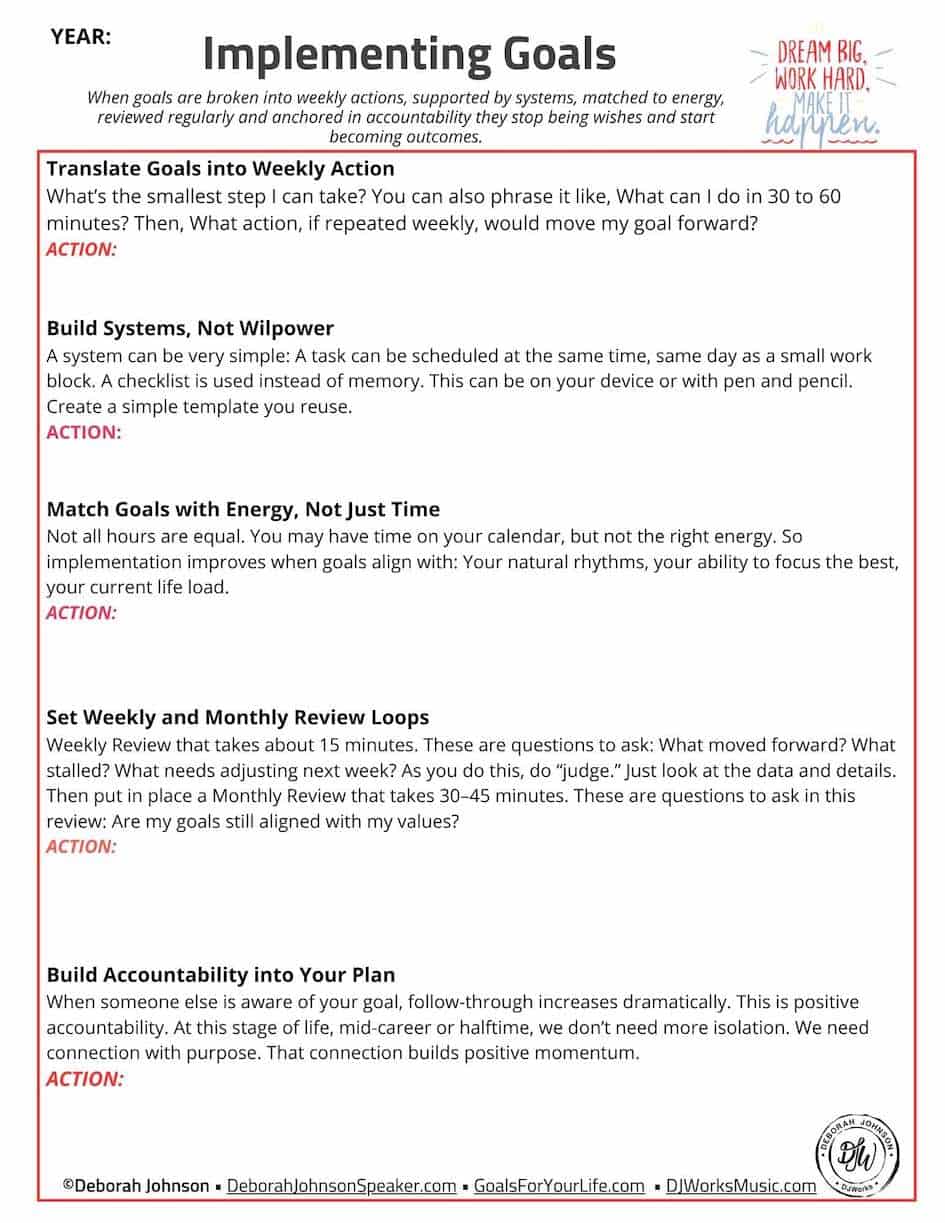
When someone else is aware of your goal, follow-through increases dramatically. This is positive accountability. At this stage of life, mid-career or halftime, we don’t need more isolation. We need connection with purpose. That connection builds positive momentum.
Common Implementation Traps
When I think of traps, I visualize those sticky traps we put out in our garage for the small rodents and critters that seem to multiply if we don’t contain them. Those are positive traps, but there are some negative ones and these are a few that we can experience:
- Trying to do too much in one quarter.
- Ignoring rest and recovery.
- Confusing busyness with progress. Sometimes that busyness feels good but it goes nowhere.
- Holding onto goals that no longer fit. That’s a hard one for many high-achievers.
Let me say this clearly: Adjusting a goal is not failure. It’s wisdom. Your life has seasons. Your goals should respect and be reflective of that fact.
Conclusion: Progress over Perfection
Successful goal implementation is not about doing more. It’s about doing what matters—consistently. And it’s also not about perfection. It’s about consistency.
When goals are broken into weekly actions, supported by systems, matched to energy, reviewed regularly and anchored in accountability they stop being wishes and start becoming outcomes.
This is how you design your next chapter with intention—instead of drifting into it.Before we close, I want to leave you with three reflection questions.
- Which goal needs a clearer weekly action?
- Where do I need better structure instead of more motivation?
- What is one system I can put in place this week?
Take small steps, be consistent in your actions and take time to be thoughtful and reflective. That’s how goals actually get implemented—especially at halftime of life. Be sure to download the companion resource or share it with someone who’s standing at their own “Power of After” moment.
Additional Resources
Goal Setting Worksheets-free download!
Atomic Habits: An Easy & Proven Way to Build Good Habits & Break Bad Ones by James Clear
Power of After: What’s Next Can Be Your Most Purposeful Chapter by Deborah Johnson
Stop Circling: Steps to Escape Endless Roundabouts by Deborah Johnson
Tiny Habits: The Small Changes that Change Everything by BJ Fogg PhD
Atomic Habits: An Easy Way to Build Good Habits and Break Bad Ones by James Clear
What we often need now at the halftime of life is better structure, not more effort.
deborah johnson
Thought Leader, Keynote Speaker, Author
If you are interested in growing and learning, check out our online courses here: Online Learning
1,741 words
