

In every season of life and career, there comes a moment when we pause and ask a powerful question: What’s next? For many professionals, entrepreneurs, and creators, that moment arrives at mid‑career or during a transition when experience is high but the direction forward may feel less clear. The good news is that we are living in a time of extraordinary opportunity. Artificial intelligence is rapidly transforming how we work, learn, and create—but perhaps its most exciting potential lies in how it can support human creativity. What I find when talking with others at mid-career or halftime of life is fear on being left behind in using or implementing AI with their experience and skillset.
An important growth mindset to implement is that AI is not simply a technology trend. It is a creative companion that can help you expand your ideas, refine your voice, and accelerate projects that might otherwise stay unfinished. Used thoughtfully, basic AI tools can become powerful partners in your next chapter—helping you write, brainstorm, repurpose, and visualize your ideas in ways that once required an entire team.
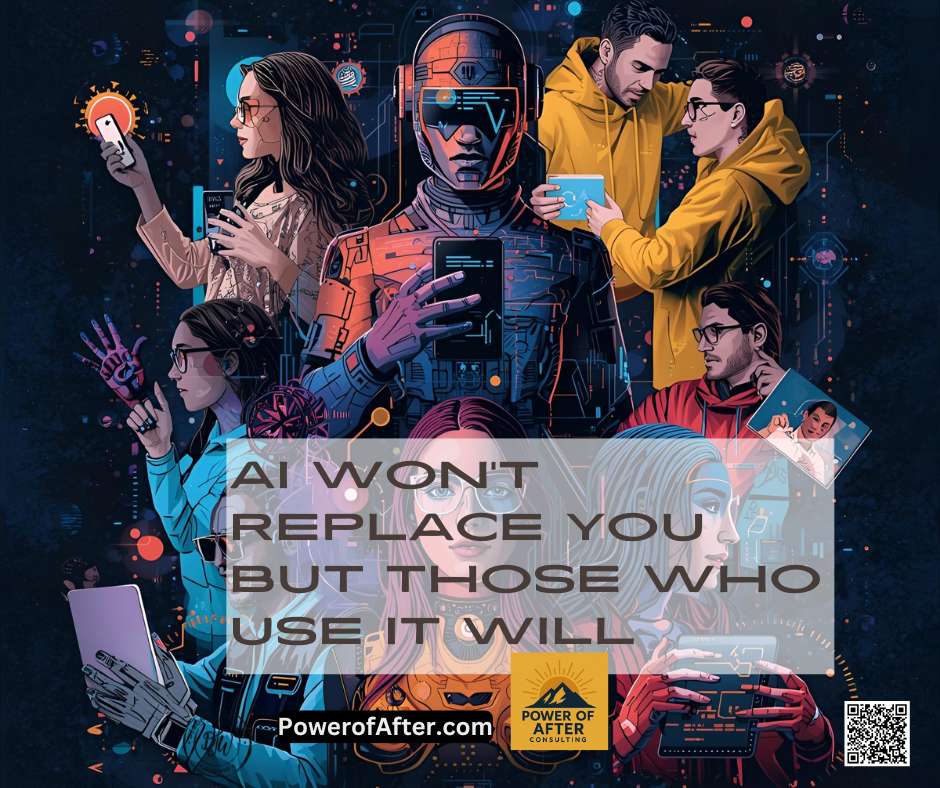
The key insight is this: AI does not replace your creativity—it amplifies it. We are going to cover some of the ways in this podcast and article.
One: Your Experience is the Foundation
Two: Mining Your Outtakes and Hidden Ideas
Three: Visualizing Your Ideas
Creativity is not limited to words. Visual storytelling plays an increasingly important role in communication, whether through presentations, social media, online courses, or marketing materials. AI image tools now allow creators to generate illustrations, backgrounds, concept art, and visual metaphors within minutes. These visuals can help bring abstract ideas to life. One of the most important aspects of creating visuals is to have a specific prompt. Even though a GPT learns our style and voice, we still need to be very specific in our requests.
For instance, if you are explaining personal growth or career transition, you might generate an image of a mountain path, a bridge between two landscapes, or a sunrise over a new horizon. You can specify the style as impressionistic, minimalistic or even futuristic. These visuals reinforce your message and make it easier for audiences to connect emotionally with your ideas.
You no longer need advanced graphic design skills to create compelling imagery. AI tools make visual creativity accessible to anyone willing to experiment.
Four: Generating New Angles and Questions
Another valuable use of AI is brainstorming. Sometimes the biggest creative barrier is not a lack of ideas but a lack of perspective and specificity. AI can help expand your thinking by suggesting new angles, questions, or examples related to your topic. If you are writing an article, planning a course, or outlining a podcast episode, an AI assistant can generate multiple approaches that you may not have considered.
I’m amazed at some of the offers and suggestions for further help after I receive the answer from a prompt. Usually I agree to hear more from Chat GPT and it inspires more conversations. These suggestions do not replace our judgment. Instead, they stimulate curiosity and help you explore directions that might otherwise remain hidden.
Many creators describe this process as “thinking out loud with a collaborator.” The interaction sparks momentum, and momentum fuels creativity. At this point, an AI tool can truly become an assistant.
If you are a creative, you understand the challenge of organization of ideas, drafts and projects. It can be overwhelming and is extremely frustrating when you can’t find projects you’ve been working on, even recently. It’s a challenge, but creativity thrives when it has structure. There are AI tools that can help organize that creative flow into simple systems.
For example, you might create folders for article ideas, podcast topics, presentation outlines, and visual assets. AI can assist in summarizing notes, organizing themes, and identifying connections between projects. Over time, this structure becomes a “content bank”—a library of ideas that can be revisited, refined, and repurposed whenever needed.
Instead of starting from scratch each time, you build upon a growing foundation of creative work. I do this a lot with writing books and have had to be even more organized as a creator because of the amount of content. There’s still a human element that is needed to make sure files are labeled in a way that makes sense in an overall system.
Five: Human Insight Remains the Differentiator
Despite all the technological excitement surrounding AI, the most important element in any creative endeavor remains human insight. AI can generate possibilities but meaning comes from interpretation. This element is extremely important to remember, especially in the arts and creative fields.
Your experiences, your stories, and your values shape the ideas that resonate with others. AI simply helps you express them more efficiently and creatively. In fact, as AI becomes more common, authentic human voices will become even more valuable. People connect with genuine stories, thoughtful perspectives, and lived experience. Technology may assist the process, but the heart of creativity remains human.
One of the most exciting aspects of AI is how quickly it allows creators to test ideas. You can experiment with writing styles, visual concepts, or content formats without committing large amounts of time or money.
This encourages a mindset of exploration. Instead of waiting for the perfect idea, you can generate several possibilities and refine the best ones. There are projects that I will be embarking on this year that were not nearly as feasible even a year ago. The technology is moving fast, expanding possibilities. It’s important to remember that creativity grows through experimentation. I have learned something through every song, article, book and musical I’ve written. And I’m excited because AI simply lowers the barriers to trying new things.
Application: Your Next Chapter
Every major transition in life invites reflection and reinvention. Whether you are launching a new project, expanding a business, starting a podcast, writing a book, or sharing your expertise in new ways, creativity will be at the center of that journey.
AI tools offer a powerful opportunity to accelerate that creative process. They help you organize ideas, refine language, generate visuals, and repurpose content so your message reaches more people. But remember: the technology is only the tool.
The real story is you—your experiences, your insights, and your willingness to keep learning and creating. Your next big chapter is not written by AI. It is written by you—with AI helping you bring the ideas to life.
Additional Resources
Goal Setting Worksheets-free download!
Hero Mountain Summit- a 5-month "Power of After" journey to help you answer "What's Next?" with your desired lifestyle & maximized skills and experience.
Power of After: What’s Next Can Be Your Most Purposeful Chapter by Deborah Johnson
Stop Circling: Steps to Escape Endless Roundabouts by Deborah Johnson
FREE Resources and links: https://GoalsForYourLife.com/DJWorks
YouTube Podcast Playlist: Women at Halftime/Power of After
AI doesn’t replace your creativity—it amplifies it.
deborah johnson
Thought Leader, Keynote Speaker, Author
If you are interested in growing and learning, check out our online courses here: Online Learning
1,776 words
